Quarvilo
Anchor Lineup
Anchor Lineup
Couldn't load pickup availability
Share
1. Problem Statement
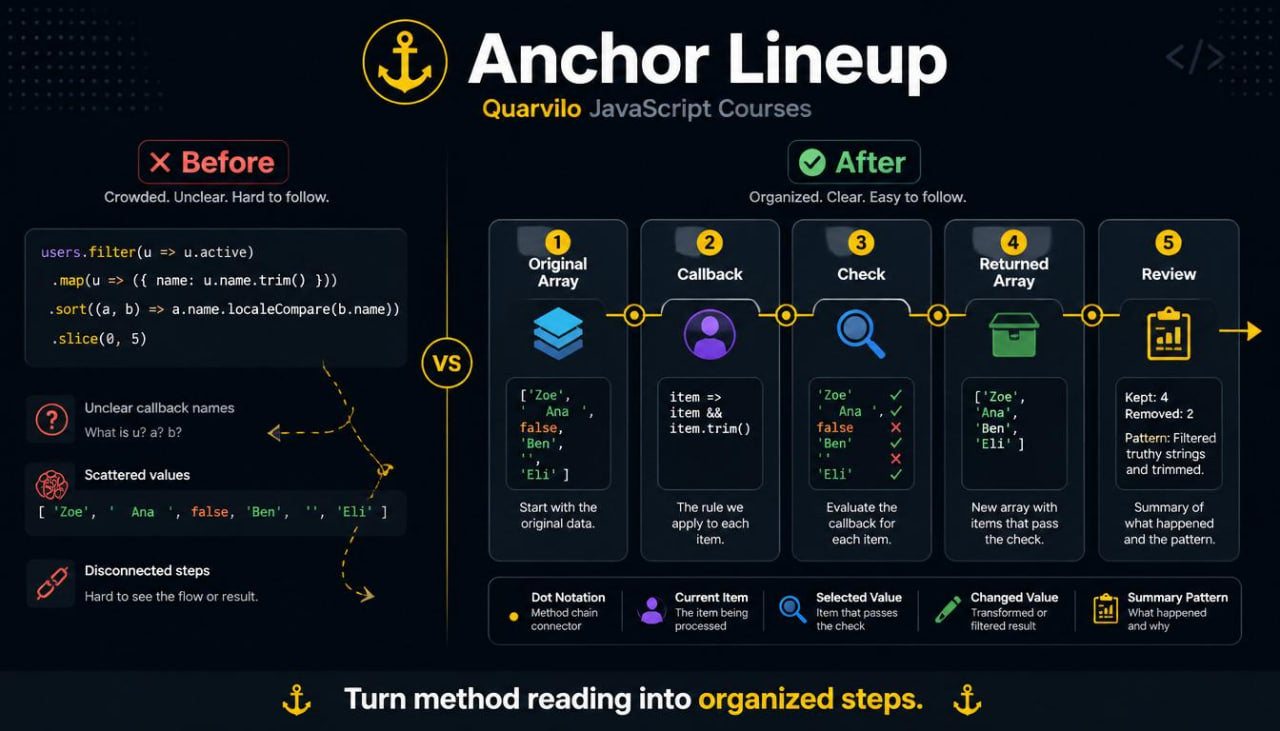
After studying loops, learners often meet shorter JavaScript examples that work with arrays in a different style. These examples may use array methods, callback functions, and chained reading patterns, which can feel unclear at first. A learner may understand how a loop moves through an array, but still feel unsure when the same idea is written with a method call and a function inside parentheses. Another challenge appears when one example includes several steps, such as selecting items, changing values, and returning a new array. Anchor Lineup was created to help learners study these patterns with order, clear comparisons, and practical review tasks.
2. Solution
Anchor Lineup introduces array methods as organized tools for working with grouped values. The course begins by comparing loop-based reading with method-based reading, so learners can connect new syntax with ideas they already studied. Each section explains one pattern at a time: reviewing each item, selecting matching values, changing each item into a new form, finding a single match, and summarizing values. The materials show how callback functions receive values, how return statements shape results, and how new arrays can be created from earlier arrays. This tier gives learners a steady way to read method-based JavaScript examples without jumping into crowded code too early.
3. What’s Inside
Anchor Lineup includes JavaScript course materials arranged around array methods and readable data flow. The course begins with a review of loops because array methods often describe repeated work in a shorter form. Learners revisit array items, index positions, current values, repeated code blocks, and returned results before moving into method-based examples.
The first module introduces the idea of an array method. Learners study how a method can be attached to an array name and used to perform a specific kind of review or change. The material explains the visual shape of a method call, including the array name, dot notation, method name, parentheses, callback function, and returned result where relevant. Examples are kept compact so learners can focus on reading each part without distraction.
The second module compares loops and array methods. Learners see the same small task written in two styles: one with a loop and one with a method. The course does not present one style as always better; instead, it helps learners notice how the structure changes. Side-by-side examples show where the array appears, where the current item is named, where the condition is placed, and where the result is formed. Practice prompts ask learners to explain both versions in plain language.
The third module focuses on item-by-item review. Learners study a method pattern that moves through each array item and performs a small action or reading step. The course explains how the callback receives the current item and how that item can be named clearly. Examples include reading labels, reviewing task names, checking count values, and printing short notes inside study examples. The goal is to help learners understand the current item before moving into methods that return new data.
The fourth module introduces selecting values from an array. Learners study examples where an array is reviewed and only matching items are placed into a new array. The material explains how a condition works inside a callback and how true-or-false results decide whether an item is included. Examples include selecting numbers above a chosen value, choosing active records, keeping labels with a certain word, and reviewing true-or-false entries. Each example includes a reading table that shows the original item, the condition result, and whether the item appears in the final array.
The fifth module focuses on changing each item into a new form. Learners study how a method can review every value and return a changed version of each item. The course explains that the original array can remain unchanged while a new array is formed from returned values. Examples include changing names into labels, converting counts into messages, building short summaries from objects, and returning selected property values. Practice tasks ask learners to predict each returned value and compare the original array with the new one.
The sixth module introduces finding a single matching value. Learners study how an array can be reviewed until a matching item is found. The material explains how this differs from selecting every match. Examples show how to find one task by name, one object by status, or one number that meets a condition. Learners practice identifying the condition, the matching item, and the returned value. This section also explains what may happen when no matching item is found, using neutral and readable examples.
The seventh module covers summary patterns. Learners study examples where several values are reviewed to produce one result, such as a total, a count, a combined label, or a grouped note. The course introduces the idea of carrying a value from one pass to the next. Examples stay small and include number totals, collected text, and simple object-based summaries. Reading notes help learners follow the starting value, the current item, the updated carried value, and the final result.
The eighth module connects array methods with objects. Learners study arrays that contain object records and learn how methods can read selected properties from each object. Examples include course section records, task cards, study notes, and small status entries. The course explains how to name the current object, how to select a property inside the callback, and how to return a value or condition from that property. Practice prompts ask learners to trace one object through a method step.
The ninth module introduces chained method reading. Learners study examples where one method result is followed by another method. This section is careful and gradual because chained code can become visually dense. The material shows how to read one step at a time: first identify the original array, then read the first method result, then pass that result into the next method. Examples are short and focus on selecting values, then changing them into readable summaries. Learners practice separating each step into a small written outline.
The tenth module focuses on callback clarity. Learners review how callback functions can be written in different forms and how naming affects readability. The course compares short parameter names with clearer names and shows how a readable callback can make an array method easier to follow. Practice tasks ask learners to rewrite unclear callback examples, rename current items, and explain what each returned value represents.
Anchor Lineup also includes recap pages after every main section. These pages summarize method shape, callback input, item review, selection, changed values, single-match search, summary patterns, object arrays, and chained reading. The recap pages are designed for repeated study before practice tasks.
The glossary section expands with terms such as array method, callback function, current item, returned array, selected item, transformed value, single match, carried value, method chain, and method result. Each term is paired with a short explanation and a compact example.
The practice area includes method-reading worksheets, loop-to-method comparison prompts, callback naming exercises, selection tasks, value-changing tasks, object-array review, chained-method outlines, and summary-result tracing. Learners are asked to describe each step in plain language and explain how values move from the original array to the final result.
4. Who Is This For?
Anchor Lineup is for learners who already understand arrays, objects, functions, conditions, and loops, and now want to study array methods in an organized way. It fits learners who can trace loop examples but feel unsure when repeated logic appears inside a method call.
This tier is also suitable for learners who want more practice with callback functions and returned values. These patterns often require careful reading because several ideas can appear inside one line. Anchor Lineup gives learners written explanations, side-by-side comparisons, and practice tasks that break method-based examples into smaller reading steps.
The course may also be useful for learners who have seen array methods before but want a clearer way to compare selection, changing, finding, and summarizing patterns. It can be used as a review tier before moving into wider code organization and mixed data examples.
Anchor Lineup is not focused on large technical systems or complex outside tools. Its focus is array method reading, callback structure, object-array examples, chained steps, and practical written study tasks.
5. What You’ll Learn
- How array methods are shaped in JavaScript examples
- How method calls differ from loop-based reading
- How callback functions receive the current item
- How to name callback values in a readable way
- How to review each item in an array
- How to select matching items into a new array
- How to change each item into a new value
- How to find one matching item in a grouped set
- How summary patterns carry a value through repeated review
- How array methods work with object records
- How to read selected properties inside callbacks
- How to separate chained methods into smaller steps
- How to compare an original array with a returned array
- How to explain method-based code in plain language
6. 30-Day Refund Note
Anchor Lineup is a paid Quarvilo course tier. After purchase, learners may review the course materials and contact Quarvilo within 30 days if the delivered materials do not match the course description. Refund requests are reviewed according to the store policy and the order details.
Do I need previous JavaScript knowledge before starting?
Do I need previous JavaScript knowledge before starting?
No previous JavaScript study is required for the opening tiers. The early sections begin with basic terms, code reading, values, variables, expressions, and small practice tasks.
Can I study at my own pace?
Can I study at my own pace?
Yes. The course materials are divided into sections, so learners can read, pause, review earlier pages, and return to tasks whenever they want.
What should I expect from higher tiers?
What should I expect from higher tiers?
Higher tiers include wider topic coverage, more examples, longer review sections, and deeper practice tasks. Each tier adds more structure and study material while staying focused on realistic JavaScript learning.
Self-paced learning overview
- 📁 Digital file available after purchase
- 🗂️ Long-term material availability
- 🔐 Secure checkout
- 🧩 Content updated in 2026