Quarvilo
Arc Collection
Arc Collection
Couldn't load pickup availability
Share
1. Problem Statement
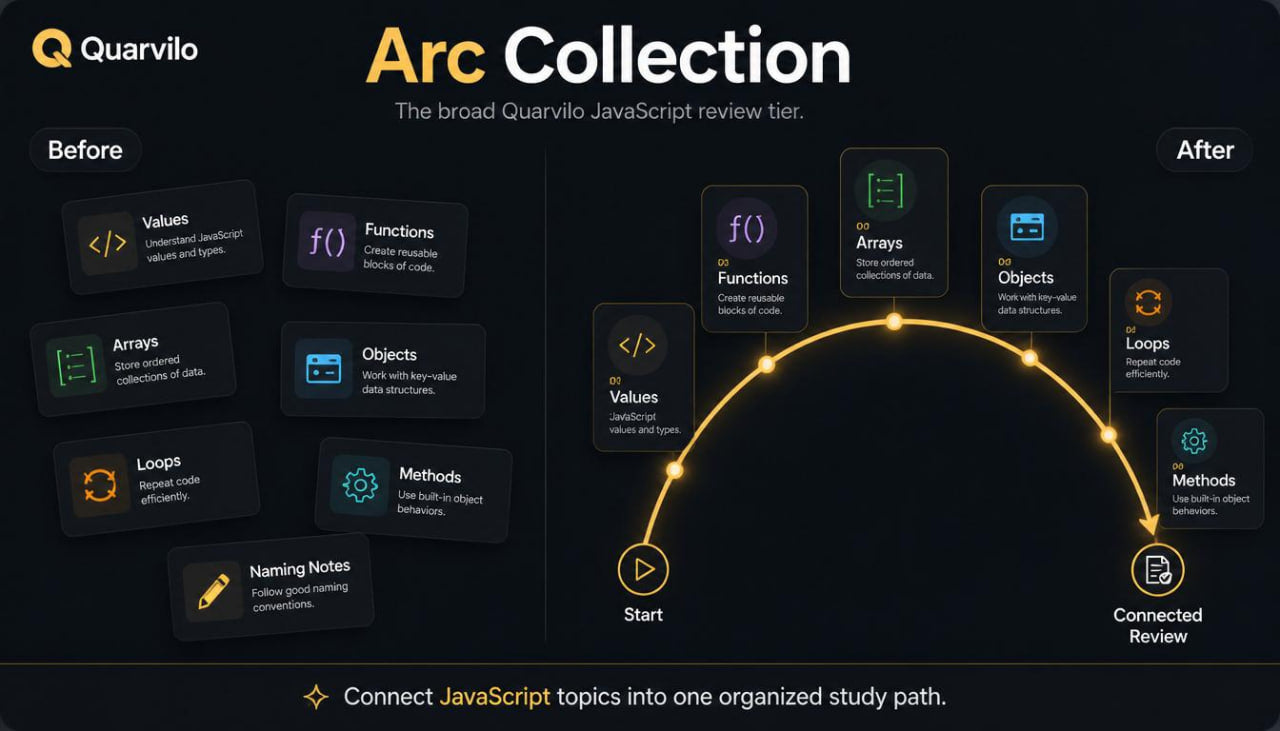
After learners move through separate JavaScript topics, they may still need a wider course structure that helps them connect everything in one place. A learner can understand functions, arrays, objects, and loops separately, yet feel unsure when all of them appear inside one longer example. Another challenge appears when learners return to earlier topics and notice gaps in code reading, naming, data tracing, or result explanation. Wider JavaScript study can also feel scattered when practice tasks do not follow a steady order. Arc Collection was created to gather the Quarvilo learning path into a detailed course tier with organized review, connected examples, and written practice sections.
2. Solution
Arc Collection gives learners a broad JavaScript study structure built around review, connection, and careful explanation. The course revisits earlier topics, then places them inside wider examples where learners can trace values from the starting data to the final result. Each section includes written notes, code-style examples, practice tasks, recap pages, and review prompts. Learners study how JavaScript parts work together inside practical learning scenarios, including object arrays, helper functions, conditions, array methods, and returned summaries. This tier supports a steady review process for learners who want a larger JavaScript course collection without unrealistic claims or pressure-based wording.
3. What’s Inside
Arc Collection includes a large set of JavaScript course materials arranged as a full review and connection tier. The course begins with a structured recap of earlier Quarvilo topics, then gradually moves into wider code examples and written study projects. Each area is built to help learners read, compare, explain, and organize JavaScript examples in a calm and detailed way.
The first section reviews JavaScript foundations. Learners revisit values, variables, expressions, operators, comparisons, and conditions. This section does not repeat earlier materials word for word; instead, it shows how foundational topics appear inside larger examples. Learners study how values are stored, compared, checked, and reused. Practice prompts ask learners to identify value types, explain expressions, review naming, and describe condition paths in plain language.
The second section reviews functions. Learners study function names, parameters, arguments, return values, helper sections, and function calls. The materials show how a function can receive simple values, arrays, objects, or mixed structures. Examples include formatting labels, checking task records, counting entries, and preparing short summaries. Each example includes a reading map that shows how the value enters the function, how it is used inside the block, and what result is returned.
The third section focuses on arrays. Learners revisit array shape, item order, index positions, item selection, length, updates, and array-based practice tasks. The course connects array knowledge with loops and array methods. Learners compare examples where an array is reviewed by index, checked through a condition, changed into a new list, or passed into a function. The section includes worksheets for tracing item movement and identifying returned arrays.
The fourth section reviews objects and structured data. Learners study property names, property values, object shape, nested objects, arrays inside objects, and object updates. The course explains how object records can describe related details and how those details can be read by property name. Examples include course sections, task cards, study notes, topic labels, and review records. Learners practice identifying object boundaries, selecting properties, comparing object shapes, and explaining nested paths.
The fifth section connects arrays and objects. Learners study arrays that contain object records and review how each record can be checked, changed, selected, or summarized. This section builds from earlier object-array topics and adds longer written exercises. Learners identify repeated property names, compare record values, trace selected records, and describe how a returned result is shaped from the original data. The examples remain readable but give learners a wider field of practice.
The sixth section reviews loops. Learners revisit starting values, stopping conditions, update steps, counters, current items, object records, and collected results. The materials explain how repeated logic can move through arrays and object records one step at a time. Practice tasks include loop tracing tables, counter review, object-record selection, and collected-result explanations. Learners are asked to write out each pass through the loop to make repeated code easier to follow.
The seventh section focuses on array methods. Learners review item-by-item reading, selection patterns, value-changing patterns, single-match search, summary patterns, callback functions, and method chains. The course compares array methods with loop-based examples so learners can see how the same idea may be written in different structures. Each method example includes notes that identify the original array, the callback input, the condition or returned value, and the final result.
The eighth section focuses on naming and organization. Learners study how variable names, function names, parameters, properties, and section labels work together. The materials include examples with unclear naming followed by revised versions with cleaner wording. Learners practice renaming variables, separating code sections, marking helper functions, and explaining why one structure reads better than another. This section is especially useful for learners who want to review larger examples without getting lost in crowded naming.
The ninth section introduces written study projects. These are not platform-based tasks and do not rely on outside tools. Instead, they are structured code-reading and code-planning exercises prepared inside the course materials. Learners work through small scenarios such as organizing course section records, reviewing a task list, counting selected entries, building short label summaries, and tracing returned objects. Each study project includes a starting data set, guided reading prompts, a code-style example, and a review checklist.
The tenth section focuses on debugging-style reading. Learners review examples where a value is placed in the wrong location, a condition checks the wrong property, a function returns the wrong shape, or a variable name makes the code harder to follow. The course presents these as study cases for careful review. Learners are asked to mark the issue, explain why the code reads incorrectly, and write a cleaner version. This section helps learners strengthen reading habits through realistic practice examples.
The eleventh section includes mixed review worksheets. These worksheets combine several topics in one example. A worksheet may include a function that receives an array of objects, checks selected records, changes them into labels, and returns a summary. Learners are guided to identify each structure, trace each value, explain each condition, and describe the returned result. The worksheet format keeps the process organized and repeatable.
The twelfth section contains recap pages and review tables. Learners receive summary pages for foundations, functions, arrays, objects, loops, array methods, naming, organization, and mixed examples. Review tables compare similar concepts such as parameters and arguments, arrays and objects, loops and methods, conditions and callback returns, selected values and returned structures. These tables are written for repeated review and careful study.
Arc Collection also includes an expanded glossary. Terms include expression, condition path, function call, argument, return value, array item, index, object property, nested value, current record, callback input, returned structure, helper function, section role, review trace, and mixed example. Each term is explained with a short note and a compact code-style reference.
The practice area is broad and detailed. It includes foundation review prompts, function tracing tasks, array worksheets, object maps, loop tables, array method exercises, naming revision tasks, organization prompts, mixed-code explanations, and written study projects. Learners are asked to read carefully, mark structures, compare examples, and explain code behavior in plain language.
4. Who Is This For?
Arc Collection is for learners who want the widest Quarvilo JavaScript course tier and prefer a structured written format. It fits learners who already studied earlier JavaScript topics and want a larger review path that connects those topics into mixed examples.
This tier is also suitable for learners who want more practice with arrays of objects, helper functions, loops, array methods, returned summaries, and organization patterns. The materials are arranged for learners who want to revisit earlier topics while also studying how they appear together.
Arc Collection may also be useful for learners who have JavaScript knowledge but want a detailed written review collection. It gives them topic recaps, practical exercises, reading maps, and wider examples without focusing on outside tools or inflated claims.
This course is not built around job claims, client claims, earnings claims, or unrealistic outcomes. Its purpose is to provide structured JavaScript study materials, detailed explanations, and practical review tasks.
5. What You’ll Learn
- How to review JavaScript foundations in connected examples
- How values, variables, expressions, and conditions work together
- How functions receive values and return results
- How arrays store ordered values and move through examples
- How objects group related details by property name
- How arrays of objects can be read, checked, and summarized
- How loops repeat actions across grouped values
- How array methods review, select, change, and summarize data
- How callback functions receive current items or records
- How helper functions support wider examples
- How naming choices affect code reading
- How to separate wider examples into readable sections
- How to trace data from the starting point to the returned result
- How to complete written study projects using JavaScript examples
- How to review debugging-style examples with careful notes
- How to explain mixed JavaScript snippets in plain language
6. 30-Day Refund Note
Arc Collection is a paid Quarvilo course tier. After purchase, learners may review the course materials and contact Quarvilo within 30 days if the delivered materials do not match the course description. Refund requests are reviewed according to the store policy and the order details.
Do I need previous JavaScript knowledge before starting?
Do I need previous JavaScript knowledge before starting?
No previous JavaScript study is required for the opening tiers. The early sections begin with basic terms, code reading, values, variables, expressions, and small practice tasks.
Can I study at my own pace?
Can I study at my own pace?
Yes. The course materials are divided into sections, so learners can read, pause, review earlier pages, and return to tasks whenever they want.
What should I expect from higher tiers?
What should I expect from higher tiers?
Higher tiers include wider topic coverage, more examples, longer review sections, and deeper practice tasks. Each tier adds more structure and study material while staying focused on realistic JavaScript learning.
Self-paced learning overview
- 📁 Digital file available after purchase
- 🗂️ Long-term material availability
- 🔐 Secure checkout
- 🧩 Content updated in 2026