Quarvilo
Halo Deck
Halo Deck
Couldn't load pickup availability
Share
1. Problem Statement
After learning the first JavaScript basics, many learners reach a point where simple code starts to look familiar, but the meaning behind each line is still not fully clear. Variables, operators, comparisons, and conditions can appear in the same example, which may make the code feel crowded. Some learners understand a single topic when it is explained alone, but they feel unsure when several small ideas work together in one snippet. Another common challenge is reading code in order and knowing which part should be observed first. Halo Deck was created to help learners slow down, organize these early concepts, and study how small JavaScript parts connect inside readable examples.
2. Solution
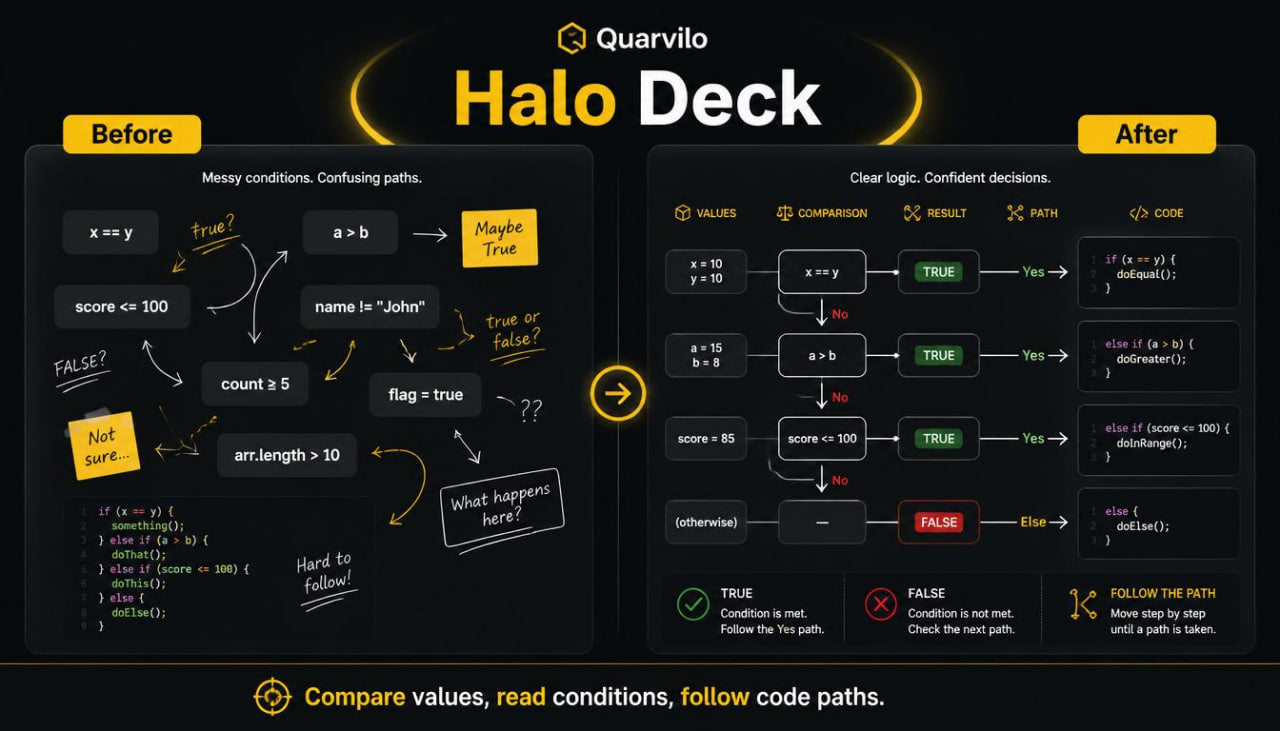
Halo Deck gives learners a wider beginner structure by combining short explanations with guided code reading and practical written tasks. The course does not rush into advanced subjects; instead, it expands the early foundation through conditions, comparisons, naming, and simple decision flow. Each module introduces one topic, shows how it appears in code, and then connects it with earlier ideas from the previous tier. Learners are guided to notice how values move through expressions, how comparisons create true-or-false results, and how conditions can guide a small code path. This tier helps learners develop a clearer study rhythm while working with JavaScript examples that remain focused and readable.
3. What’s Inside
Halo Deck includes a structured set of JavaScript course materials arranged into focused modules, recap pages, examples, and practice tasks. The course begins with a short review of the core topics from the opening tier: values, variables, naming, and expressions. This review is not written as a repetition of the same material; it shows how those ideas appear again when learners begin working with comparisons and conditions.
The first module reviews JavaScript values in a more connected way. Learners revisit text values, number values, true-or-false values, and empty or missing values. The material explains how these values may appear inside variables, expressions, and simple checks. Short examples show how a value can be assigned to a name, compared with another value, or used as part of a condition. The module also includes small reading tasks where learners identify the type of value being used in each line.
The second module focuses on operators. Learners study arithmetic operators, text joining, comparison operators, and basic logical operators. Each operator is introduced with a short explanation, followed by examples that show how it changes or compares values. The course pays attention to how learners read an expression from left to right, when parentheses make the order clearer, and why small symbol differences can change the meaning of code. Practice prompts ask learners to match expressions with their likely results and explain what each part does.
The third module introduces comparisons. Learners explore how JavaScript can compare values and produce true-or-false results. The course explains equality checks, difference checks, greater-than and less-than comparisons, and simple comparison patterns. Instead of presenting comparisons as isolated symbols, the module places them inside readable examples so learners can see why a comparison might be used. Review tasks ask learners to predict the result of small comparison snippets and rewrite unclear examples into cleaner ones.
The fourth module introduces conditions. Learners study how a condition can guide whether a block of code is read as active in a given example. The material explains the shape of a basic condition, the role of parentheses, the use of code blocks, and the difference between one path and another. Examples include small checks based on age values, item counts, status names, and simple text comparisons. The goal is to help learners read the condition, identify the checked value, and understand what happens when the condition is met.
The fifth module expands conditions with alternative paths. Learners study how one condition can be paired with another path when the first check is not met. This section explains how code can describe more than one possible route while still remaining readable. Examples are kept small so learners can focus on structure rather than large logic. Practice tasks ask learners to label each path, rewrite condition names, and explain which block belongs to which check.
The sixth module focuses on code comments and reading habits. Learners explore how short comments can explain the purpose of a line or section without replacing the need to read the code itself. The course shows useful and less useful comment examples, helping learners notice when a comment adds clarity and when it simply repeats the line. This section also includes a guided reading method: identify names, identify values, identify operators, find the condition, and then read the code block.
Halo Deck also includes a set of recap pages at the end of each module. These pages summarize operators, comparisons, condition structure, code blocks, and common reading patterns. The recap sections are written for review, so learners can return to them before completing practice tasks or before moving into another tier.
The course includes a glossary expansion with terms such as operator, comparison, condition, block, branch, boolean result, expression result, equality check, and logical operator. Each term is paired with a short explanation and a compact example. This helps learners connect vocabulary with actual code structure.
The practice section includes code-reading worksheets, fill-in-the-blank prompts, short rewrite tasks, and small explanation exercises. Learners are asked to read examples carefully, describe what a condition is checking, choose clearer variable names, and identify how values are compared. These tasks are built for steady review and practical understanding, not speed.
4. Who Is This For?
Halo Deck is for learners who have already looked at basic JavaScript ideas and want a more organized way to study the next layer. It works well for people who understand simple values and variables but feel unsure when operators, comparisons, and conditions appear together. This tier is also suitable for learners who want to improve code-reading habits before moving into larger topics.
This course may fit learners who prefer written explanations, short code examples, and practice prompts that can be completed at a personal pace. The materials are arranged so each topic builds from the previous one, allowing learners to revisit earlier pages when needed. It is also useful for people who want a calmer study path instead of jumping into broad JavaScript topics too early.
Halo Deck is not meant for advanced JavaScript study. It does not focus on large applications, complex architecture, outside libraries, or advanced technical patterns. Its purpose is to strengthen early reading, comparison, and condition skills before learners continue into wider JavaScript course collections.
5. What You’ll Learn
- How to review values and variables in connected examples
- How arithmetic and comparison operators work in small snippets
- How text values and number values behave in simple expressions
- How true-or-false results are created through comparisons
- How to read equality checks and difference checks
- How conditions guide small code paths
- How code blocks are connected to condition statements
- How alternative paths can be written and read
- How to identify the checked value inside a condition
- How to use short comments for clearer code reading
- How to recognize unclear naming and rewrite it with better structure
- How to explain simple JavaScript snippets in plain language
- How to complete condition-based practice tasks
- How to prepare for future topics such as functions and collections
6. 30-Day Refund Note
Halo Deck is a paid Quarvilo course tier. After purchase, learners may review the course materials and contact Quarvilo within 30 days if the delivered materials do not match the course description. Refund requests are reviewed according to the store policy and the order details.
Do I need previous JavaScript knowledge before starting?
Do I need previous JavaScript knowledge before starting?
No previous JavaScript study is required for the opening tiers. The early sections begin with basic terms, code reading, values, variables, expressions, and small practice tasks.
Can I study at my own pace?
Can I study at my own pace?
Yes. The course materials are divided into sections, so learners can read, pause, review earlier pages, and return to tasks whenever they want.
What should I expect from higher tiers?
What should I expect from higher tiers?
Higher tiers include wider topic coverage, more examples, longer review sections, and deeper practice tasks. Each tier adds more structure and study material while staying focused on realistic JavaScript learning.
Self-paced learning overview
- 📁 Digital file available after purchase
- 🗂️ Long-term material availability
- 🔐 Secure checkout
- 🧩 Content updated in 2026