Quarvilo
Lattice Module
Lattice Module
Couldn't load pickup availability
Share
1. Problem Statement
After learners become familiar with values, variables, expressions, comparisons, and conditions, the next challenge is understanding how JavaScript groups repeated actions. A code example may become harder to follow when the same kind of logic appears in several places. Learners may understand a condition on its own, but feel uncertain when that condition is placed inside a named function. Parameters and return values can also feel abstract because they describe how data enters and leaves a block of code. Lattice Module was created to make these ideas more readable through careful explanations, small examples, and guided practice tasks.
2. Solution
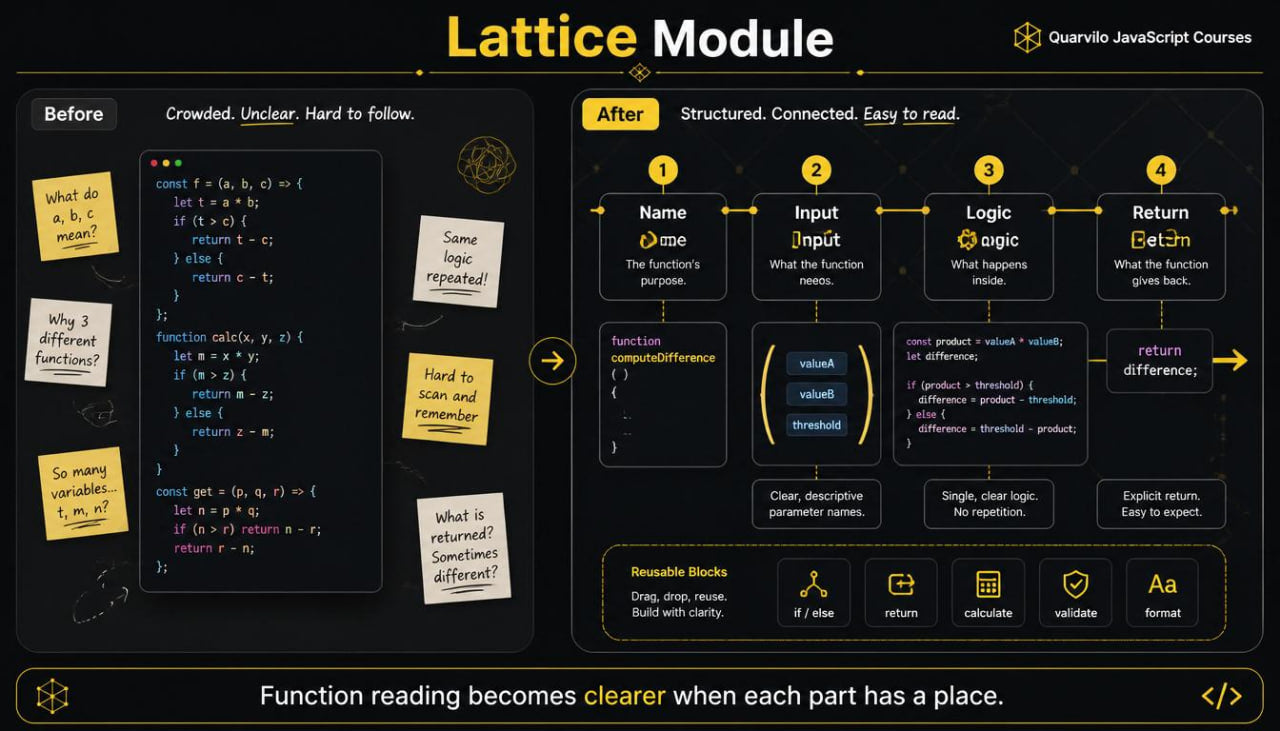
Lattice Module introduces functions as named sections of code that can receive values, work with them, and send back a result. The course explains each part of a function slowly: the name, the parentheses, the parameters, the code block, and the return statement. Learners see how earlier topics appear again inside function examples, including variables, comparisons, conditions, and expressions. Each module connects one concept to another so learners can understand not only what a function looks like, but why its structure matters. The course gives learners a steady way to study reusable logic without jumping into large or crowded examples too early.
3. What’s Inside
Lattice Module includes written JavaScript course materials arranged around the theme of reusable logic. The course begins with a short review of earlier topics, including variables, operators, comparisons, and condition blocks. This review prepares learners to see how those pieces appear inside functions and how they work together within a named structure.
The first module introduces the basic shape of a function. Learners study how a function begins with a name, how parentheses are used, and how the code block holds the instructions connected to that function. The material explains that a function can be read as a reusable section of code with a specific task. Examples are kept small, such as greeting text, number checks, simple totals, and message formatting. Each example includes reading notes that identify the function name, the input area, the body, and the part that produces an output.
The second module focuses on naming. Learners study why function names should describe the action or calculation being performed. The course compares vague names with clearer names and asks learners to notice how naming changes the reading experience. This section includes practice tasks where learners rename functions, explain what a name suggests, and match names with short code blocks. The purpose is to help learners see naming as part of structure, not decoration.
The third module introduces parameters. Learners explore how parameters act as named placeholders for values that will be given to a function. The course explains the difference between the name written in the function definition and the actual value passed into the function when it is used. Examples show text parameters, number parameters, and simple true-or-false parameters. Practice prompts ask learners to identify which value is being passed in and how that value is used inside the code block.
The fourth module explains arguments. Learners compare parameters and arguments through side-by-side examples. The material shows how a function may define one or more parameters, then receive actual values when called. This section is useful for learners who feel unsure about why two related terms are used. Each example includes a small table that separates the function definition from the function call, helping learners read the relationship between them.
The fifth module focuses on return values. Learners study how a function can send back a result that may be stored, displayed, compared, or used in another expression. The course explains the return statement with simple number calculations, text formatting, and condition-based examples. Learners see how code after a return statement may not be part of the returned result, and why return placement matters. Practice tasks ask learners to predict what value is returned from each function and explain the path that leads to that result.
The sixth module connects functions with conditions. Learners study small examples where a function receives a value, checks it with a condition, and returns a result based on that check. The course keeps these examples compact so learners can focus on reading the flow. Examples may include checking a count, reviewing a status word, comparing two values, or selecting a short message. Each example is paired with notes that guide learners through the path of the value from input to result.
The seventh module introduces function reuse. Learners see how the same function can be called with different values. The course explains that reuse does not mean copying the same block repeatedly; instead, a named function can describe a pattern that works with different inputs. Practice tasks ask learners to compare several calls of the same function and identify why the output changes.
The eighth module focuses on common reading mistakes. Learners review examples where a function name is unclear, a parameter name is confusing, a return statement is missing, or a condition is placed in a way that makes the code harder to read. The course does not present these as failures, but as normal study moments that can be reviewed and corrected. Learners rewrite small snippets with cleaner naming, clearer order, and more readable structure.
Lattice Module also includes recap pages after each main section. These pages summarize the function shape, parameter use, argument passing, return values, and condition-based function flow. The recap pages are written for repeat review and can be used before completing practice tasks.
The glossary section expands with terms such as function, function call, parameter, argument, return value, reusable logic, function body, input value, output value, and named block. Each term is explained in plain language and paired with a short code sample where helpful.
The practice area includes code-reading worksheets, rewrite prompts, naming exercises, return-value prediction tasks, and small function-building activities. Learners are asked to read code carefully, identify each part of the function, trace how values move, and describe what the function returns. The tasks are shaped for steady study and practical understanding.
4. Who Is This For?
Lattice Module is for learners who already understand basic JavaScript values, variables, expressions, and conditions, and now want to study functions in an organized way. It fits learners who can read small snippets but feel unsure when code is grouped into named blocks.
This tier is also suitable for learners who want more practice with parameters and return values. These topics often require repeated reading because they describe how information moves through code. Lattice Module gives learners enough examples to compare different cases without overwhelming them with large code files.
The course may also be useful for learners who have seen functions before but want a cleaner explanation of their parts. It can serve as a review tier for people who want to revisit naming, inputs, outputs, and reusable logic before moving into arrays, objects, and wider JavaScript structures.
Lattice Module is not designed around advanced architecture or large technical systems. Its focus is functions, readable logic, and practical study tasks that help learners understand how small JavaScript blocks are shaped and used.
5. What You’ll Learn
- How to identify the main parts of a JavaScript function
- How function names describe a task or calculation
- How parameters work as named placeholders
- How arguments provide actual values during a function call
- How values move through a function body
- How return statements send back a result
- How to predict the result of small function examples
- How conditions can be used inside functions
- How one function can be reused with different values
- How to compare vague and clearer function names
- How to rewrite small functions for better readability
- How to trace input values through a code block
- How to explain function behavior in plain language
- How to prepare for later topics such as arrays and objects
6. 30-Day Refund Note
Lattice Module is a paid Quarvilo course tier. After purchase, learners may review the course materials and contact Quarvilo within 30 days if the delivered materials do not match the course description. Refund requests are reviewed according to the store policy and the order details.
Do I need previous JavaScript knowledge before starting?
Do I need previous JavaScript knowledge before starting?
No previous JavaScript study is required for the opening tiers. The early sections begin with basic terms, code reading, values, variables, expressions, and small practice tasks.
Can I study at my own pace?
Can I study at my own pace?
Yes. The course materials are divided into sections, so learners can read, pause, review earlier pages, and return to tasks whenever they want.
What should I expect from higher tiers?
What should I expect from higher tiers?
Higher tiers include wider topic coverage, more examples, longer review sections, and deeper practice tasks. Each tier adds more structure and study material while staying focused on realistic JavaScript learning.
Self-paced learning overview
- 📁 Digital file available after purchase
- 🗂️ Long-term material availability
- 🔐 Secure checkout
- 🧩 Content updated in 2026