Quarvilo
Loom Pattern
Loom Pattern
Couldn't load pickup availability
Share
1. Problem Statement
After learners study arrays and objects, they often meet code examples where the same action needs to happen several times. Reading repeated code can become confusing because the learner has to follow a value, an index, a condition, and a code block at the same time. Loops may look small at first, but the meaning of each part can feel unclear when the structure includes counters, array items, object properties, or return values. Another challenge appears when learners need to understand what changes during each pass through the loop. Loom Pattern was created to make repeated JavaScript actions easier to study through organized written modules, small examples, and guided review tasks.
2. Solution
Loom Pattern explains loops as structured ways to repeat an action while reading or checking data. The course begins with the idea of repetition, then introduces loop shape, counters, array movement, object review, and condition-based checks inside repeated code. Each module connects loops with earlier Quarvilo topics, including variables, arrays, objects, functions, conditions, and return values. Learners study how a loop begins, how it continues, what changes each time, and when the repeated action stops. The course gives learners a practical method for reading repeated logic without relying on rushed examples or crowded explanations.
3. What’s Inside
Loom Pattern includes a detailed set of JavaScript study materials centered on loops and repeated code structure. The course begins with a review of arrays and objects because loops often work with grouped data. Learners revisit array order, index positions, object properties, and function flow before moving into repeated actions.
The first module introduces repetition in code. Learners study why a repeated action may be written once and then applied to several values. The material uses plain examples such as reviewing names, counting items, checking labels, and reading task records. This section explains that repetition is not just about doing the same thing again; it is about using a structured pattern so the code can move through related values in an organized way.
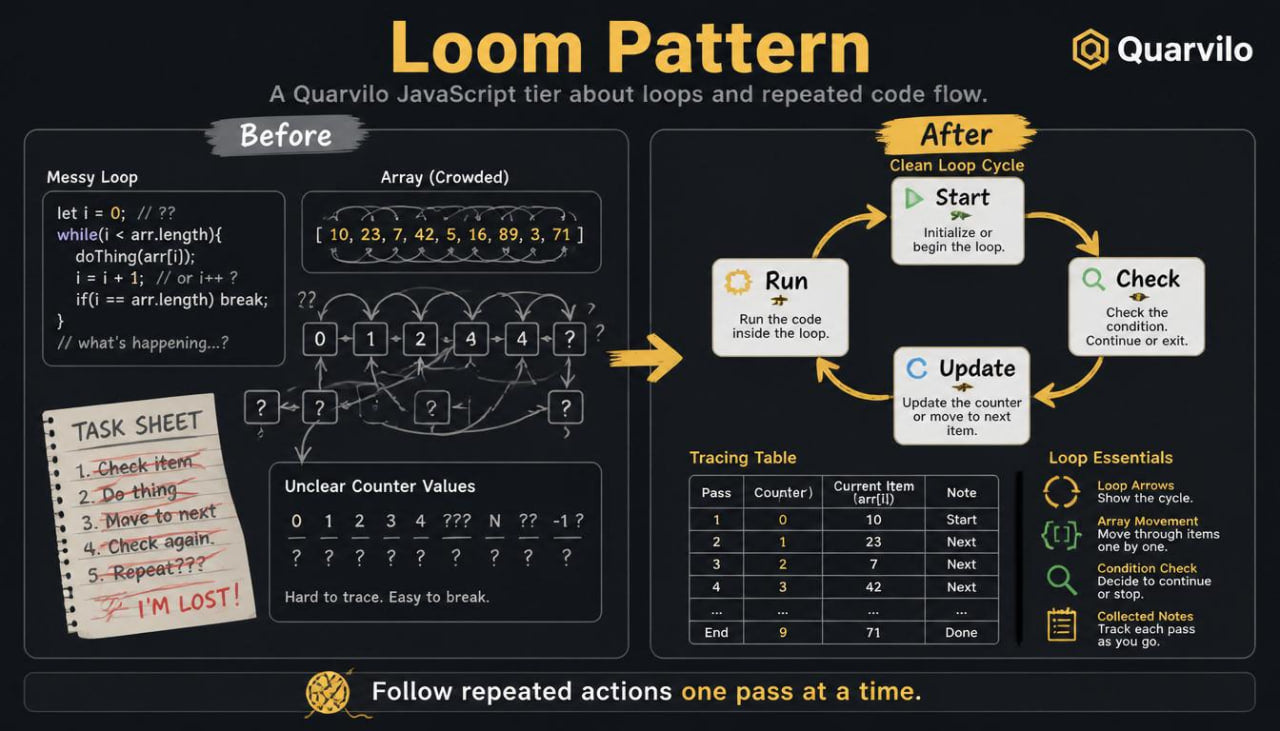
The second module introduces the visual shape of a loop. Learners study the parts of a basic loop structure, including the starting value, the condition that keeps the loop running, the code block, and the update step. The course explains each part separately before showing the full example together. Reading notes help learners identify where the loop starts, what it checks, what it does, and what changes after each pass.
The third module focuses on counters. Learners study how a number value can track the current position in repeated code. The course explains why counters often begin at zero when working with arrays, how a counter can increase, and how the counter relates to index positions. Examples show small arrays and a counter moving from the first item to later items. Practice prompts ask learners to trace the counter value and match it with the item being read.
The fourth module connects loops with arrays. Learners study how a loop can move through an array one item at a time. The course explains how the array name, index position, and loop counter work together. Reading tables show each pass through the loop, the counter value, the selected item, and the action performed inside the code block. This helps learners see repeated flow as a sequence of readable steps rather than a single dense snippet.
The fifth module introduces conditions inside loops. Learners review examples where a loop checks each item and responds only when a condition is met. The course uses small examples such as checking numbers above a certain value, finding a matching label, reviewing true-or-false entries, or counting selected items. Each example is paired with notes that separate the repeated movement from the condition check. Practice tasks ask learners to identify which values are checked and which pass through without a change.
The sixth module connects loops with functions. Learners study how a function can receive an array, loop through its values, and return a result. This section revisits parameters, arguments, return values, and condition blocks from earlier tiers. Examples include counting items, reading the first matching value, checking whether a list contains a chosen word, and building a small summary from several entries. The course explains how the function receives the data, how the loop reviews it, and how the return value is formed.
The seventh module introduces object review with loops. Learners study examples where objects are placed inside an array, creating a list of structured records. The material explains how each object can be read during a loop and how selected properties can be checked. Examples include small course section records, task cards, learner notes, and item summaries. Learners practice identifying the current object, reading one property, and explaining how the condition uses that property.
The eighth module focuses on collected results. Learners study how a loop can create a new list of selected values or gathered notes. The course explains this through compact examples where an empty array begins the process, selected values are added during the loop, and the final array is returned or reviewed. The material keeps the examples small so learners can clearly follow what is added and why.
The ninth module covers common loop reading mistakes. Learners review examples where the counter starts at an unclear value, the stopping condition is wrong, the update step is missing, or the selected item is not clearly named. The course treats these as normal study cases that can be examined and corrected. Practice prompts ask learners to mark the unclear part, rewrite names, and explain how the loop should be read.
The tenth module includes a guided loop-reading worksheet. Learners receive several small snippets and study them through a repeated method: identify the data, identify the starting value, read the condition, follow the selected item, observe the update step, and describe the final result. This method helps learners slow down and read repeated code with order.
Loom Pattern also includes recap pages after each major section. These pages summarize loop shape, counters, array movement, conditions inside loops, function-based loops, object records, collected results, and common reading issues. The recap pages are written for repeat review and can be used before completing the practice area.
The glossary section expands with terms such as loop, iteration, counter, starting value, stopping condition, update step, current item, repeated block, collected result, and loop trace. Each term includes a short explanation and a compact code-style example.
The practice area includes loop tracing tables, counter exercises, array reading tasks, condition review prompts, object-record worksheets, function tracing tasks, and collected-result examples. Learners are asked to explain each pass through a loop, describe what changes, and identify the final result in plain language.
4. Who Is This For?
Loom Pattern is for learners who already understand variables, conditions, functions, arrays, and objects, and now want to study repeated code flow in an organized way. It is suitable for learners who can read individual examples but feel uncertain when the same action repeats through several values.
This tier is also useful for learners who want additional practice with array movement and object records. Loops often bring several earlier topics together, so learners may need repeated reading before the full structure feels familiar. Loom Pattern gives them structured materials, recap notes, and practice tasks that focus on how repeated logic works.
The course may also support learners who have already seen loops but want a clearer explanation of counters, stopping conditions, selected items, and collected results. It can be used as a review tier before studying array methods, wider data handling, and larger code organization.
Loom Pattern is not centered on large technical systems or complex project work. Its focus is loop reading, repeated actions, data review, and practical written study tasks.
5. What You’ll Learn
- How repeated actions are written in JavaScript examples
- How to identify the main parts of a loop
- How starting values, conditions, and update steps work together
- How counters relate to array index positions
- How to trace an array item through each loop pass
- How conditions can be used inside repeated code
- How a function can receive an array and return a loop-based result
- How to read arrays that contain object records
- How to identify the current object inside a loop
- How to read selected properties during repeated review
- How a loop can collect selected values into a new array
- How to spot unclear loop names and rewrite them with cleaner structure
- How to use tracing tables for repeated code study
- How to explain loop examples in plain language
6. 30-Day Refund Note
Loom Pattern is a paid Quarvilo course tier. After purchase, learners may review the course materials and contact Quarvilo within 30 days if the delivered materials do not match the course description. Refund requests are reviewed according to the store policy and the order details.
Do I need previous JavaScript knowledge before starting?
Do I need previous JavaScript knowledge before starting?
No previous JavaScript study is required for the opening tiers. The early sections begin with basic terms, code reading, values, variables, expressions, and small practice tasks.
Can I study at my own pace?
Can I study at my own pace?
Yes. The course materials are divided into sections, so learners can read, pause, review earlier pages, and return to tasks whenever they want.
What should I expect from higher tiers?
What should I expect from higher tiers?
Higher tiers include wider topic coverage, more examples, longer review sections, and deeper practice tasks. Each tier adds more structure and study material while staying focused on realistic JavaScript learning.
Self-paced learning overview
- 📁 Digital file available after purchase
- 🗂️ Long-term material availability
- 🔐 Secure checkout
- 🧩 Content updated in 2026