Quarvilo
Slate Collection
Slate Collection
Couldn't load pickup availability
Share
1. Problem Statement
After learners study mixed JavaScript examples, another challenge appears: understanding how code can stay readable when it grows beyond short snippets. Values, functions, arrays, objects, loops, and methods may all be familiar alone, but a wider example can still feel difficult when many named parts sit close together. Learners may also struggle to decide where one section begins, where another section ends, and why some code is grouped separately. Without a steady reading routine, longer examples can feel like a flat wall of text rather than a set of connected parts. Slate Collection was created to help learners study organization patterns, naming habits, and section-based JavaScript reading with calm structure.
2. Solution
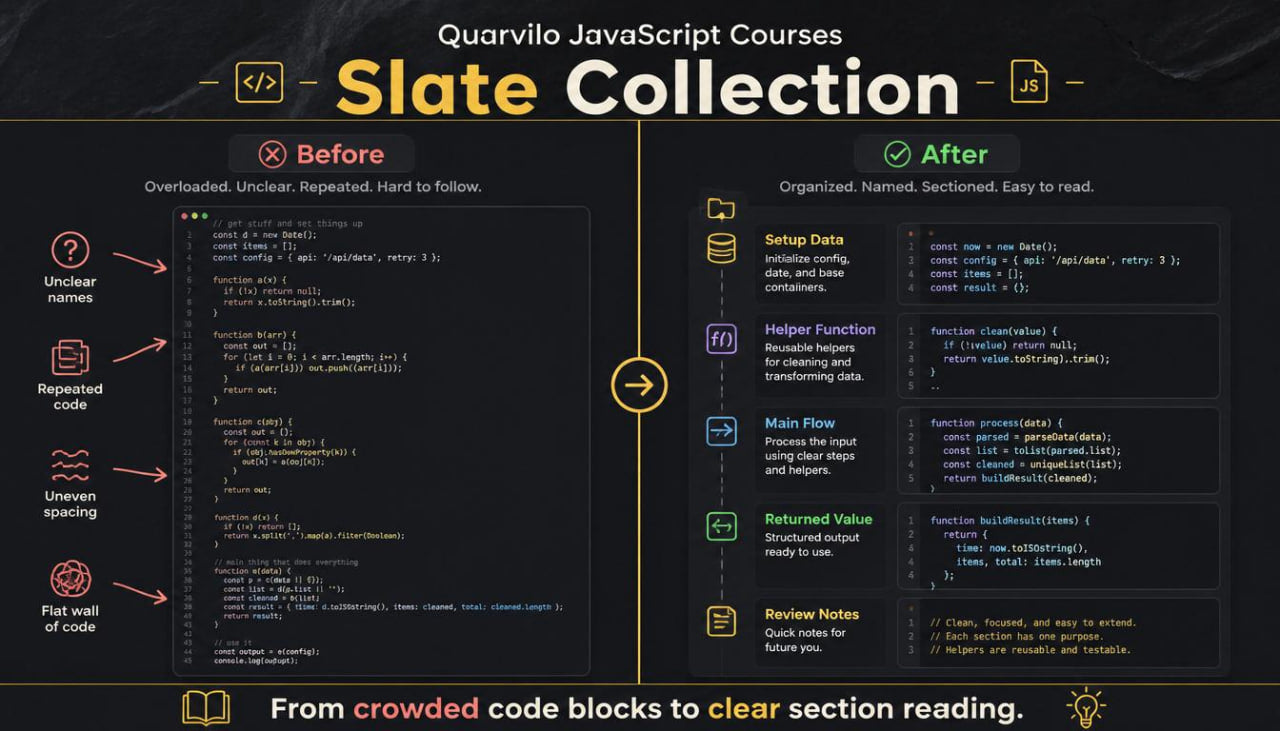
Slate Collection teaches learners to look at JavaScript code as a set of named sections with clear roles. The course explains how values, functions, object records, array methods, and helper sections can be arranged so each part is easier to read and review. Learners study examples by separating setup data, reusable functions, repeated data handling, returned results, and final review lines. Each module introduces a practical reading method that can be used on wider examples without rushing through details. This tier gives learners a structured way to understand how JavaScript materials can be arranged into readable blocks.
3. What’s Inside
Slate Collection includes detailed JavaScript study materials centered on code organization and section-based reading. The course begins with a review of connected examples from earlier tiers, including functions, arrays, objects, loops, array methods, and nested structures. This review prepares learners to study not only what the code does, but also where each part belongs in a wider example.
The first module introduces the idea of code sections. Learners study how a longer example can be divided into visible parts such as data setup, helper functions, main reading flow, returned result, and review output. The material explains why section order matters and how grouping related lines can make review more manageable. Examples show short course-data records, task lists, and summary functions arranged into labeled sections. Practice prompts ask learners to mark each section and explain its role.
The second module focuses on naming systems. Learners review how variable names, function names, parameter names, and property names work together inside a wider code example. The course compares unclear naming with more readable naming and shows how consistent wording can make related parts easier to connect. Examples include names for records, lists, current items, returned values, and helper functions. Learners complete rewrite tasks where they improve naming across several connected lines.
The third module introduces helper functions. Learners study how one larger task can be divided into smaller named functions. The course explains how a helper function can format a value, check a condition, select a property, or prepare a short result. Examples show one main function using smaller helper functions to keep the reading flow organized. Each example includes notes that identify what the helper receives, what it returns, and how the main function uses that returned value.
The fourth module focuses on input and output reading. Learners study how to trace information from the starting value into one function, through helper sections, and into a final result. The material uses reading maps that show each named step in order. Examples include a list of course sections being filtered, mapped into labels, counted, or summarized into a small object. Practice tasks ask learners to draw or write a path for each value being used.
The fifth module covers section comments and study notes. Learners explore how short notes can label code regions, explain a chosen structure, or mark a study task. The course shows how comments can support reading without repeating every line. Examples include notes above data setup, notes before helper functions, and notes that explain why a condition is being checked. Learners are asked to compare useful section notes with vague notes and revise them for better reading value.
The sixth module connects organization with arrays of objects. Learners study examples where a data group appears first, then helper functions process that data in separate steps. The course revisits property reading, selected records, method-based review, and result shaping. Examples include sections with titles, levels, task counts, status labels, and review notes. Each example is broken into sections so learners can see how data structure and function structure relate to one another.
The seventh module introduces multi-step result shaping. Learners study examples where grouped data is selected, changed, summarized, or returned in a cleaner form. The material explains how each step changes the shape of the information. Examples include selecting active records, turning records into labels, counting matching entries, and preparing short summary objects. Practice prompts ask learners to compare the starting data, each intermediate result, and the final returned structure.
The eighth module focuses on reading order. Learners study how to decide where to begin when a wider example includes many functions. The course explains a practical approach: identify the final call, find the named function being used, read its parameters, check helper functions only when they appear in the flow, and then return to the final result. This method helps learners avoid reading every line randomly. Worksheets guide learners through wider examples using this same order.
The ninth module introduces grouping by purpose. Learners study how code sections can be arranged around roles such as data, checks, formatting, selection, review, and result creation. The course explains that organization is not only about spacing; it is about helping the reader understand why each part exists. Examples show the same code arranged in a crowded form and then in a cleaner section-based form. Learners mark which version is easier to explain and why.
The tenth module covers review of repeated patterns. Learners revisit common structures from earlier tiers, including function calls, object records, array methods, conditions, and returned arrays. The difference in this tier is that the examples are larger and require learners to recognize familiar patterns across several sections. Practice tasks ask learners to identify repeated patterns, mark their roles, and describe how they help shape the final result.
The eleventh module focuses on refactoring as a study topic. Learners study small examples where code is rewritten into clearer names, smaller functions, or better section order. The course presents this as a reading and organization exercise, not as a claim of technical perfection. Learners compare before-and-after snippets, explain what changed, and describe how the new structure supports clearer review.
The twelfth module includes a full guided reading worksheet. Learners receive a wider JavaScript example with data, helper functions, conditions, array methods, and a returned summary. The worksheet guides them through marking sections, tracing values, labeling helpers, identifying returned results, and writing a plain-language explanation of the full example. This final section brings together the organizational habits studied across the tier.
Slate Collection also includes recap pages after each main module. These pages summarize code sections, naming systems, helper functions, input-output paths, section notes, object-array organization, multi-step result shaping, reading order, grouping by purpose, repeated patterns, and refactoring study. The recap pages are useful for returning to key ideas before practice.
The glossary section expands with terms such as helper function, section role, input path, returned structure, reading order, section note, refactoring, grouped logic, intermediate result, and main flow. Each term is explained with a compact example and a plain-language note.
The practice area includes section-marking worksheets, naming revision tasks, helper-function tracing, input-output maps, object-array organization prompts, multi-step result review, reading-order exercises, and refactoring comparisons. Learners are asked to explain how each part of a wider example supports the final result.
4. Who Is This For?
Slate Collection is for learners who already understand JavaScript basics, functions, arrays, objects, loops, array methods, and mixed examples, and now want to study organization in wider code samples. It fits learners who can read short snippets but feel unsure when several sections are arranged together.
This tier is also suitable for learners who want more practice with naming systems, helper functions, and section-based reading. These topics are useful when examples contain several related parts and require a careful review method.
The course may also help learners who have studied earlier Quarvilo tiers and want a wider bridge between topic-based study and larger JavaScript materials. It gives learners structured reading tasks that focus on organization, value paths, returned results, and clearer explanation.
Slate Collection is not centered on large outside systems or claims about future outcomes. Its focus is code organization, section reading, helper functions, data flow, refactoring study, and practical written tasks.
5. What You’ll Learn
- How to divide wider JavaScript examples into readable sections
- How to identify setup data, helper functions, main flow, and returned results
- How naming systems connect variables, functions, parameters, and properties
- How helper functions support section-based organization
- How to trace values from input to final result
- How short section notes can support review
- How arrays of objects can be arranged with helper functions
- How multi-step result shaping works in wider examples
- How to choose a reading order for code with several functions
- How to group code by purpose
- How to recognize repeated patterns across wider examples
- How to compare crowded snippets with cleaner rewritten versions
- How to explain refactoring changes in plain language
- How to prepare for the final Quarvilo collection tier
6. 30-Day Refund Note
Slate Collection is a paid Quarvilo course tier. After purchase, learners may review the course materials and contact Quarvilo within 30 days if the delivered materials do not match the course description. Refund requests are reviewed according to the store policy and the order details.
Do I need previous JavaScript knowledge before starting?
Do I need previous JavaScript knowledge before starting?
No previous JavaScript study is required for the opening tiers. The early sections begin with basic terms, code reading, values, variables, expressions, and small practice tasks.
Can I study at my own pace?
Can I study at my own pace?
Yes. The course materials are divided into sections, so learners can read, pause, review earlier pages, and return to tasks whenever they want.
What should I expect from higher tiers?
What should I expect from higher tiers?
Higher tiers include wider topic coverage, more examples, longer review sections, and deeper practice tasks. Each tier adds more structure and study material while staying focused on realistic JavaScript learning.
Self-paced learning overview
- 📁 Digital file available after purchase
- 🗂️ Long-term material availability
- 🔐 Secure checkout
- 🧩 Content updated in 2026